
How the Shield of the Americas could divide Latin American countries.
- Mar 29
- 4 min read
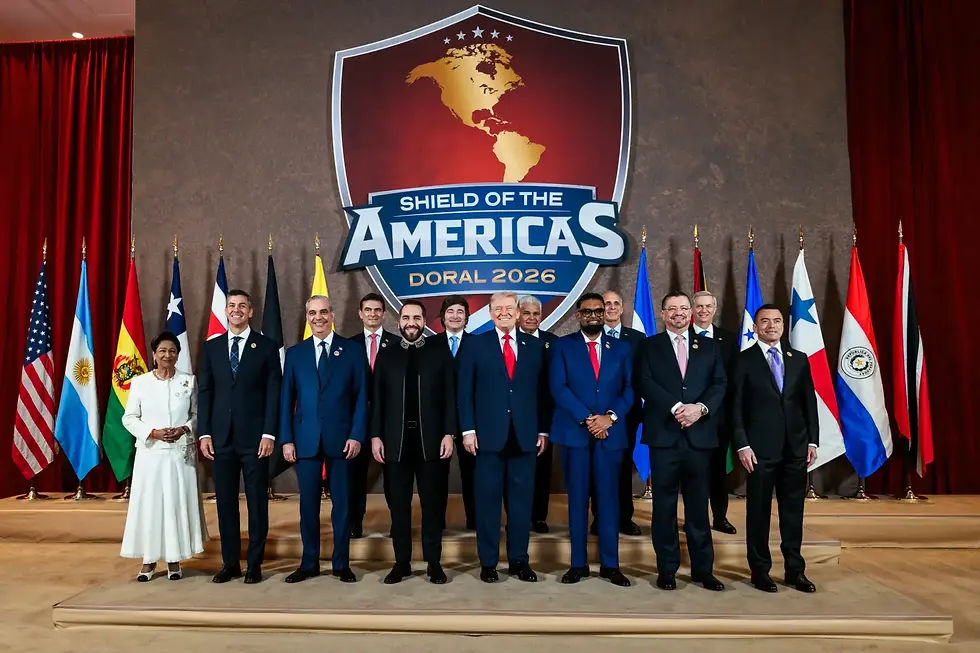
On March 7th, Donald Trump redirected his focus to Latin America and proposed a multilateral initiative by launching the "Shield of the Americas": a military coalition composed of 17 Latin American countries with the goal of combating drug trafficking and cartels, as well as massive movements of illegal immigration and foreign interference in the hemisphere.
During the summit held in Doral, Florida, 12 leaders who share the conservative ideals of the US president met to discuss such an "anti-cartel" coalition—representatives from Bolivia, Chile, Argentina, Paraguay, Ecuador, Costa Rica, El Salvador, Guyana, Honduras, Trinidad and Tobago, Panama, and the Dominican Republic were present. Trump expressed concern about Mexico, which he referred to as the epicenter of the violence involving the cartels and one of those responsible for the chaos in the Americas, a source of danger precisely because of its close proximity to US territory.
Furthermore, Trump also highlighted the commitment to using military force against drug cartels, praising American attacks on boats accused of drug trafficking: "We'll put a missile in the cartel boss's living room if you want."
White House representatives reinforced the intent of the cooperation led by the United States: the defense of American sovereignty, security, and economic prosperity, as well as the well-being and overcoming of challenges faced by its Latin American neighbors. "We want you to see that when you are a friend and ally of the United States, that's a good thing and it's reciprocal," stated US Secretary of State Marco Rubio.
Furthermore, reaffirming his position of control and leadership in the Western Hemisphere, containing the advancement of relations between China and Russia with Latin America would be one of Trump's major aspirations through the Shield of the Americas. According to the American leader, foreign influence will not be tolerated nor will it gain ground in strategic regions such as the Panama Canal. However , the absence of some countries of extreme importance to the flow of events occurring in Latin America, especially regarding drug trafficking, was noteworthy. Brazil, Colombia, and Mexico were left out of the Shield of the Americas, and their representatives did not attend the summit organized by Trump. While the majority present were conservative right-wing heads of state, the lack of left-wing presidents, who had previously criticized Trump's handling of drug policy, explains this exclusion by the United States. In some cases, such as Brazil, the refusal to recognize factions as terrorist organizations, such as Comando Vermelho, displeased Trump.
The meeting culminated in a half-page declaration, signed by all countries present at the event, which agreed on the four main points at stake — military coalition against drug cartels and narcoterrorism, integration of military intelligence and cooperation to contain transnational crimes, “minilateralism,” which consists of groups of ideologically aligned countries acting quickly, and clauses that open loopholes for US attacks and interventions.
The adherence of most Latin American countries to the new strategy of the United States government reveals a successful attempt to re-establish absolute American hegemony in the Western Hemisphere. The Monroe Doctrine, summarized by the motto "America for the Americans" in 1823, resurfaces in 2026 under the new perspective that Donald Trump has given it, which has been called the "Donroe Doctrine".
For Latin American countries, the Shield of the Americas threatens national sovereignty. The rhetoric of direct intervention, mentioned earlier, is seen as a real threat after Operation Absolute Resolve, which culminated in the invasion of Caracas, Venezuela, and the capture of Nicolás Maduro in January 2026. For the countries that signed the pact, accepting US troops or precision strikes on their territories establishes a state of military dependence.
Unlike traditional diplomatic alliances, Secretary Marco Rubio made it clear that friendship with Washington now requires forced reciprocity: to gain access to the American market and protection, countries must limit their infrastructure from Chinese influence (such as 5G and control of the Panama Canal) and adopt the US list of enemies.
On the one hand, Trump secures a safety net with ideological allies subservient to his military and economic interests. On the other hand, the use of strategic "minilateralism" ends up isolating the US from the region's largest economies—Brazil, Mexico, and Colombia, currently led by left-leaning figures, who tend to gravitate more towards economic cooperation offered by China than towards hegemonic attempts by the United States.
Brazil, in particular, has been the target of pressure from the United States to classify factions such as the PCC (Primeiro Comando da Capital) and Comando Vermelho as foreign terrorist organizations, which would create precedents to justify military intervention under the idea that the Brazilian state would be incapable of combating them. Positioning itself as neutral regarding the Shield of the Americas is an undesirable attitude for the United States, but it is still better for Brazil than supporting an initiative that could curtail its autonomy.
The potential consequences for Latin America are alarming, as the region moves towards ideological and military bipolarization, in which national sovereignty may be sacrificed in the name of hegemonic security that allows direct interventions. The end result may not be the eradication of trafficking, but rather a fragmented continent, lacking dialogue between governments with differing ideologies, which increases political instability and external dependence on a single power center.


Comments