
The U.S. Tightens Measures Against Cuba: How Far Does the Legality of Sanctions Go?
- Mar 26
- 6 min read

Cuba faces its most severe survival crisis in decades following the new commercial offensive by the United States. On January 29, 2026, President Donald Trump signed an Executive Order authorizing the imposition of tariffs on any country that trades with the island, specifically targeting the supply of oil and its derivatives.
The official justification behind the document argues that the Cuban government represents an “unusual and extraordinary threat to U.S. national security and foreign policy,” through alliances with hostile actors such as Russia, China, and Iran. Furthermore, the measure would aim to contain the spread of communist doctrine across Latin America, as part of a national security strategy intended to align countries in the region with the United States.
However, in an interview with reporters at the White House, Trump implied that the undeclared objective of the measure would be regime change in Cuba, similar to what was intended in Venezuela. According to the president, the Cuban government had been in talks with the U.S. government after losing its main oil supplier following the fall of Nicolás Maduro’s government in Venezuela in January 2026, which until then had been the only regime aligned with Cuba in Latin America. The supply was interrupted by the U.S. government after military action in Caracas, in which it took control of Venezuela’s oil sector and sought to economically encircle the island of Cuba.
This executive order would serve as a means of pressuring the Caribbean island toward a political transition, signaling a “friendly takeover of Cuba,” suggesting that, in the face of economic and energy collapse, the Cuban government would have no alternative but to accept a regime change shaped by the United States.
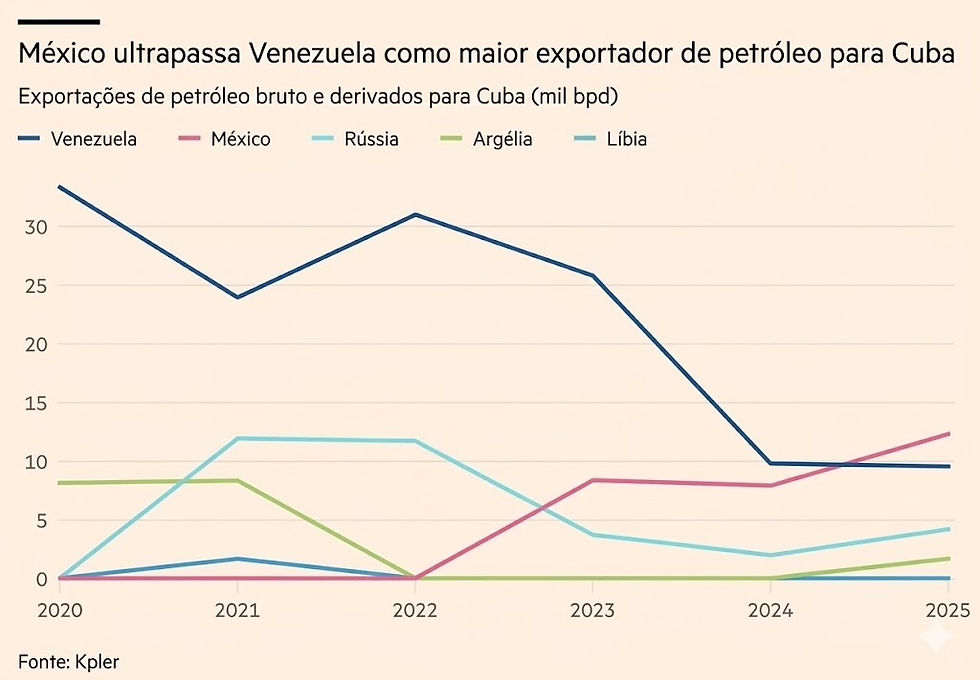
This chart shows the largest exporters of oil to Cuba, with Venezuela in purple, Mexico in pink, Russia in cyan blue, Algeria in green, and Libya in blue.
Mexico, which under the presidency of Claudia Sheinbaum had surpassed Venezuela as the main exporter to the island in 2025, suspended new shipments out of fear of U.S. tariff retaliation. Although Sheinbaum described the sanctions as “unjust” and reaffirmed her commitment to humanitarian aid, Cuba received only one Mexican shipment of 84.9 thousand barrels of oil throughout early 2026, further worsening its energy and economic crisis.
Sheinbaum also signaled Mexico’s willingness to mediate a possible dialogue between the United States and Cuba. At the same time, she reaffirmed the historical pillars of Mexican diplomacy, such as the self-determination of peoples and non-intervention, reinforcing the country’s traditional stance of solidarity with Latin American nations, especially Cuba.
This is not the first time Cuba has faced severe sanctions from the United States, whose trade embargo has continued to expand since 1958. Moreover, the North American country uses its global power and influence to pressure Latin American leaders to adhere to Cuba’s isolation.
Thus, a large portion of Latin American countries with left-leaning governments have clearly condemned the actions declared by Donald Trump. In addition to Mexico, which sent ships carrying humanitarian aid, Chile also contributed by donating one million dollars to assist the island during the crisis. Other countries, such as Brazil, expressed political support by criticizing U.S. actions but without taking concrete and direct measures to assist Cuba. Venezuela’s current president, Delcy Rodríguez—formerly vice president under Nicolás Maduro and who assumed office after the events of January—declared “Caracas’ solidarity” and reiterated condemnation of U.S. pressure.
Allies outside the continent, such as China, are attempting to mitigate the energy collapse through support for solar energy projects, but the scale of this assistance remains insufficient to contain the widespread blackout threatening the regime’s stability.
Among Central American countries, Nicaragua is the only partner of the Caribbean island; however, it has not provided materials or other forms of support and has also changed its visa regulations for Cuban citizens, making visas now mandatory.
However, right-leaning countries tend to support the actions of Donald Trump’s government, as seen in Costa Rica, Panama, and El Salvador. Nayib Bukele, president of the latter, broke a 27-year agreement that involved sending Cuban doctors to work in the country following pressure from Trump. More than 400 Cuban professionals are now awaiting their return to their country of origin. Honduras, whose president Nasry Asfura is also an ally of Trump, intends to follow the same path as Bukele and terminate contracts with Cuban doctors in its territory. Currently, around 30,000 Cuban doctors are working in 67 countries, generating approximately 10 billion dollars in revenue for the island’s economy.
Another country demonstrating unconditional support for President Donald Trump’s measures is Argentina. Its current president, Javier Milei, who took office in 2023, has adopted a firm stance regarding sanctions against Cuba. In 2024, during a vote at the United Nations General Assembly to lift U.S. sanctions against Cuba, he stated that he would dismiss all foreign ministry officials who voted against the sanctions: “All the people involved in this decision are here to be fired. They are traitors to the country. We are analyzing the legal framework to fire them and make them pay.”
Many Latin American leaders have expressed concern that instability in Cuba could generate a migration crisis and potentially affect regional stability.
Cuba has been facing U.S. sanctions for more than six decades, and the situation worsened after the fall of its ally, the Soviet Union; since then, the island has lived amid the difficulties of commercial isolation. The recent removal of Maduro’s government in Venezuela directly affected the island’s energy capacity, as both countries were politically aligned against U.S. hegemony. The latest U.S. sanctions further reinforce the island’s lack of self-sufficiency.
The Caribbean island relies primarily on fossil fuels as its main energy source, a demand that is almost entirely met through imports; without the ability to import, the country is forced to implement power cuts. Cuba’s economy has been slowing down, and the social situation worsens by the day, with numerous blackouts and difficulties in maintaining the transportation network. Many residents report that there is no longer fuel available for purchase, with an endless virtual queue to acquire it, leaving walking as the only option for carrying out daily activities.
In addition to the paralysis of transportation, Cuban markets are empty; products have increased in price due to the recent devaluation of the Cuban peso, and there is no longer any restocking. Cuban president Miguel Díaz-Canel advised the population to adapt their diets to the country’s new reality: “we must accept that food will no longer circulate, so we need to consume what is produced locally; it is necessary to resist.” The population opposes U.S. intervention and seeks to resist and ensure Cuban sovereignty. Annual protests against U.S. hegemony on the island take place every January 27, a tradition established by Fidel Castro. Thus, it becomes clear that despite the hardships faced by the population, there is a strong desire to resist.
As a result, discussions about Cuba’s energy transition have become increasingly common. The island has favorable conditions for solar and wind energy; however, the transition is relatively slow and has been underutilized so far. Meanwhile, Cuba needs partners willing to challenge U.S. embargoes, such as Russia, which has already announced the shipment of fuel as humanitarian aid to the island. However, Vladimir Putin advised those planning to travel to Cuba to reconsider until the situation stabilizes. Russia is the second-largest source of tourists to Cuba, second only to Canada. Putin also stated that Russian airlines will temporarily suspend flights to Cuba after evacuating tourists stranded on the island.
This is not the first time Donald Trump has challenged the sovereignty of other states under the pretext of promoting regime change, which raises debate over the legality of his actions. In international law, the decision to classify a country as a threat to national security can be questioned when used to impose unilateral economic blockades, as a state’s sovereignty should not be subordinated to internal security interests.
Moreover, the U.S. Executive Order challenges the limits of the United Nations Charter, which prohibits the use of coercive measures to impose the political will of one state upon another sovereign state. Although the United States attempts to frame these sanctions as a response to humanitarian crises, it is evident that such actions prioritize geopolitical interests over the well-being of the civilian population, which suffers the most severe side effects.
It is important to emphasize that Donald Trump did not seek this multilateral backing, acting unilaterally and ignoring the global consensus that, annually at the UN General Assembly, almost unanimously condemns the embargo on Cuba as an anachronistic and illegal practice.


Comments